
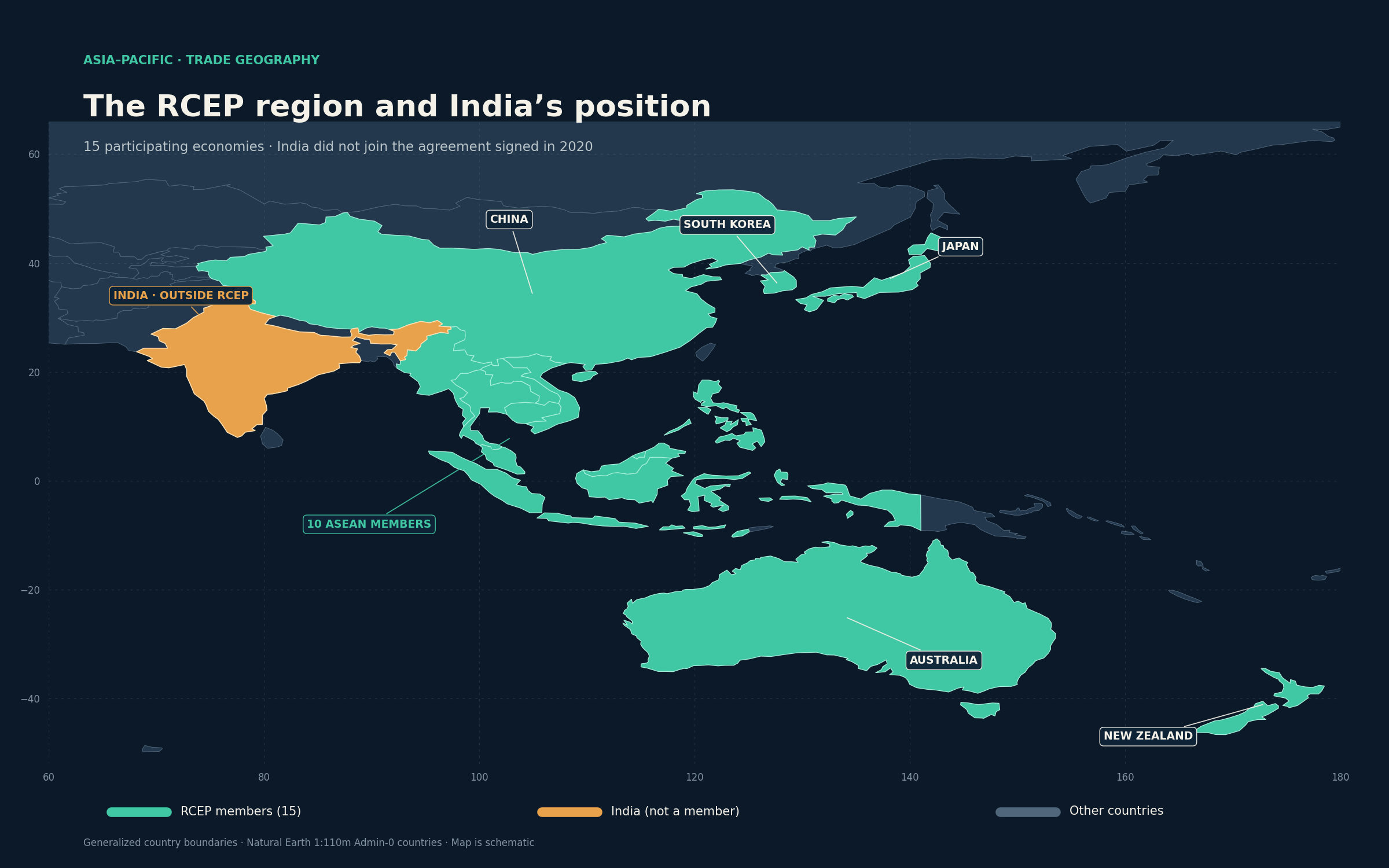
Geopolitical strength is not measured only by the number of agreements a country signs. It is also measured by whether its leaders can examine the terms, weigh the domestic consequences, and decline an arrangement that does not yet serve the national interest. India’s 2019 decision not to join the Regional Comprehensive Economic Partnership (RCEP) is best understood in that light: as a negotiating choice made over the agreement’s then-current terms, rather than a rejection of trade or regional cooperation.
RCEP brings together the ten ASEAN member states with Australia, China, Japan, New Zealand, and South Korea. India took part in the negotiations but did not sign when the agreement was concluded in 2020. ASEAN describes RCEP as a major regional trade framework intended to widen market access, strengthen supply chains, and support economic integration. Its scale gives members opportunities to coordinate production across borders. Staying outside such a framework therefore carried a real opportunity cost for India.
That cost should be acknowledged. A trade agreement can help firms reach customers, source inputs, and participate in regional value chains. The World Bank’s 2024 India Development Update discussed modelled estimates that India could gain substantially from joining RCEP, while also noting possible trade diversion if the agreement’s preferences shifted business toward member economies. These are projections from economic models, not observed results or guarantees. Still, they represent a serious argument for deeper regional integration, and any defense of India’s choice should confront them directly.
India’s stated reasoning in 2019 was about the balance and design of the agreement. At the Bangkok leaders’ summit on 4 November, India said the structure then on the table did not reflect RCEP’s guiding principles or resolve its outstanding concerns. The Ministry of Commerce later said India did not join because the arrangement did not adequately address the ambitions and concerns of Indian stakeholders. Prime Minister Narendra Modi had described India’s preferred outcome as comprehensive, balanced, and mutually beneficial, and had highlighted concerns about unsustainable trade deficits.
The distinction matters. India did not claim that trade with Asian partners was undesirable. It argued that opening its market under a particular set of rules would be difficult to justify if the gains and risks were not reasonably balanced. In a country where farming, dairy, small manufacturers, and large numbers of workers depend on domestic markets, policymakers had to consider how rapidly increased imports might affect vulnerable producers. Such concerns do not prove that every feared effect would have occurred. They do explain why a government might insist on stronger safeguards, credible rules of origin, and clearer protection against sudden import surges before accepting a wide-ranging pact.
The decision also preserved India’s ability to negotiate on its own timetable. A country does not strengthen its bargaining position by accepting every regional initiative simply because it is large. It strengthens that position by stating what conditions would make an agreement sustainable, then continuing to seek partners and market access elsewhere. India’s subsequent record is relevant here: it brought the UAE Comprehensive Economic Partnership Agreement into force in May 2022, implemented the Australia Economic Cooperation and Trade Agreement in December 2022, and brought the India–EFTA Trade and Economic Partnership Agreement into force in October 2025. India has also pursued other agreements and negotiations. These steps show that the RCEP decision did not end India’s trade diplomacy.
This more selective approach can be defended as an expression of strategic autonomy. In practical terms, strategic autonomy means retaining room to choose policies after weighing national needs, rather than treating alignment with any one economic bloc as automatic. India can cooperate with ASEAN, trade with China, deepen economic ties with Australia and Japan, and still judge each agreement on its own terms. That flexibility is valuable in a period when supply chains, technology rules, energy security, and strategic competition increasingly overlap.
A decision made in 2019 should not become permanent doctrine. The world economy has changed, India’s capacity has changed, and the terms available in future negotiations may differ from those rejected. The World Bank’s analysis is a reminder that remaining outside RCEP may carry long-term costs through missed market access and trade diversion. India should therefore keep reviewing its regional integration strategy. If future negotiations can address concerns over reciprocity, safeguards, rules of origin, and access for Indian goods and services, reopening the question could serve India’s interests.
The strongest case for India’s decision is thus conditional and forward-looking. In 2019, the government judged that RCEP’s then-current structure did not resolve important concerns. It was reasonable to refuse terms that policymakers considered unbalanced, particularly when domestic adjustment and import competition posed real political and economic questions. But refusal is only a sound strategy when it leads to better preparation: more competitive firms, lower logistics costs, predictable trade rules, and negotiated access to markets that Indian exporters can use.
An effective response should pair measured protection with verifiable reform at home. The World Bank report recommends reducing trade costs, making customs processes more transparent, lowering trade barriers, and improving exporters’ access to imported inputs. Those steps matter because tariffs alone cannot build export strength. Better infrastructure and predictable rules help Indian firms meet standards, ship on time, and compete on price and quality. India can defend a cautious negotiating stance while making domestic producers more capable of using the market access secured through future agreements. Regular reviews should measure which sectors benefited, where imports surged, and whether safeguards remained proportionate, giving negotiators evidence for the next round.
India’s choice should be defended on those grounds—not as proof that regional trade is harmful, and not as a guarantee that staying out produced a net economic gain. The record supports a more careful conclusion: India retained the right to negotiate, continued signing selected trade agreements, and left open the possibility that future regional terms could be better. That is a defensible exercise of national judgment. Its lasting success will depend on whether India converts that bargaining space into stronger exports, productive jobs, and a more resilient role in Asian supply chains.